
Documentation
Roughness
VFX Loom 1.0 reference for the Roughness node.
Filters
processing.roughness 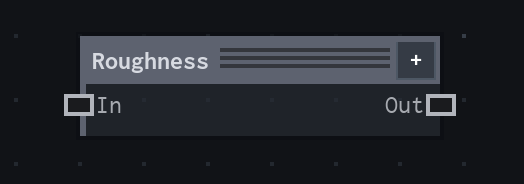
Overview
Creates a grayscale roughness material map. Black is smooth; white is rough.
Outputs grayscale RGB where black is smooth and white is rough; source alpha is copied exactly.
- Category
- Filters
- Internal ID
processing.roughness- Version
- VFX Loom 1.0
Inputs
| Input | Type | Required | Default | Meaning |
|---|---|---|---|---|
| in | Image | Required | — | See the overview for the node's documented behavior. |
Properties
| Property | Type | Default | Animatable | Range / options | Effect |
|---|---|---|---|---|---|
| Source Channel | Enum | Luminance | Not declared | Luminance · Alpha · Red · Green · Blue | Selects the source channel behavior; each option changes the operation described in the overview. |
| Min | Scalar | .15 | Yes | — | Animatable control; changing it over time varies the node response. |
| Max | Scalar | .85 | Yes | — | Animatable control; changing it over time varies the node response. |
| Contrast | Scalar | 1 | Yes | UI range: soft | Animatable control; changing it over time varies the node response. |
| Invert | Bool | false | Not declared | — | Local control documented by the production node behavior. |
Outputs
| Output | Type | Meaning |
|---|---|---|
| out | Image | The production node output described by the overview. |
Usage
In practice
- Use Roughness when the graph needs Creates a grayscale roughness material map. Black is smooth; white is rough.
- Outputs grayscale RGB where black is smooth and white is rough; source alpha is copied exactly.
- Place it after the image or mask it should process, and check its alpha and edge behavior before using the result in a tiled graph.
Notes / limitations
- No step is declared for Min, Max, or Contrast.